Laser hair removal is a popular option for people who want to reduce unwanted facial or body hair without relying on frequent shaving, waxing, or threading.
One of the most common questions before starting treatment is: How many laser hair removal sessions will I need?
The answer depends on several factors, including your hair color, hair thickness, skin tone, treatment area, hormonal influences, and the laser device used.
Many people require approximately 4–6 sessions or more, spaced several weeks apart, to achieve meaningful hair reduction. Some individuals need additional sessions and occasional maintenance treatments.
Laser hair removal can produce long-lasting hair reduction, but it does not guarantee that every hair will be permanently removed.
Understanding how treatment works and what affects the results can help you plan your appointments and set realistic expectations.
How Does Laser Hair Removal Work?
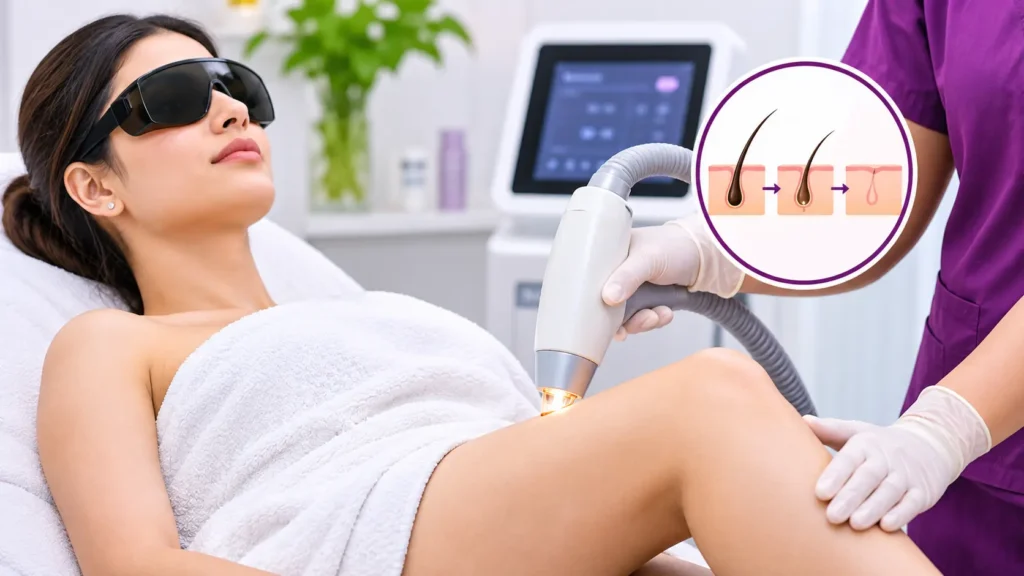
Laser hair removal uses concentrated light energy to target pigment within the hair.
The pigment absorbs the energy, which produces heat and can damage structures involved in hair growth.
When the appropriate follicular structures are affected, future hair growth may be reduced.
However, not every follicle responds equally during one treatment.
Hair follicles move through different growth stages, and their response to laser energy depends partly on the stage they are in when treatment occurs.
This is why one session usually cannot produce the full intended result.
The equipment, settings, skin characteristics, and experience of the practitioner also influence treatment effectiveness and safety.
Why Are Multiple Laser Hair Removal Sessions Needed?
Hair grows in cycles rather than continuously at the same rate.
The three commonly described growth stages are:
Anagen — Active Growth Phase
During anagen, the hair is actively growing and remains closely associated with structures within the follicle.
Laser treatment is generally most effective when suitable pigmented hair is in the appropriate active growth stage.
Catagen — Transitional Phase
Catagen is a shorter transitional stage when active hair growth slows and the follicle begins changing.
Hair in this phase may respond differently to treatment.
Telogen — Resting Phase
During telogen, the follicle is resting before a new growth cycle begins.
Hair follicles in different areas of the body do not all enter the same growth phase at once.
Because of this variation, treatments are spaced over time to target additional follicles during suitable growth stages.
Multiple sessions increase the opportunity to affect more of the unwanted hair.
How Many Laser Hair Removal Sessions Are Usually Required?
There is no universal session count for every individual.
Medical guidance commonly discusses an initial series of approximately four to six sessions, with some patients requiring six or more.
The number should be treated as an estimate rather than a guarantee.
| Treatment area | General considerations |
| Upper lip | Hormonal influences and finer facial hair may affect the response |
| Chin | Persistent or hormonally influenced growth may require additional assessment |
| Underarms | Coarse, pigmented hair may respond well in suitable patients |
| Arms | Response depends on pigmentation, thickness, and hair density |
| Legs | Multiple appointments are commonly required |
| Bikini area | Hair characteristics, skin tone, and device selection affect outcomes |
| Back and chest | Large treatment areas and hormonal factors may influence the number of sessions |
| Full body | Different areas may respond at different rates |
These are general considerations, not prescribed session counts.
A qualified practitioner should provide an individualized estimate after evaluating the treatment area.
What Factors Affect the Number of Sessions?
1. Hair Color
Laser treatment commonly relies on pigment within the hair to absorb energy.
Dark, pigmented hair generally responds more predictably than very light, gray, white, or red hair.
Some hair colors may respond poorly to conventional laser hair removal technologies.
The available technology should be discussed before treatment.
2. Hair Thickness
Coarse hair often contains more pigment than very fine hair.
This may make certain coarse hairs more responsive to appropriately selected laser treatment.
Fine or lightly pigmented hair may be more difficult to treat effectively.
3. Skin Tone
Laser devices and settings must be selected carefully according to skin tone and other individual characteristics.
People with darker skin tones can undergo laser hair removal, but inappropriate device selection or settings can increase the risk of burns and pigmentation changes.
The practitioner should have experience treating people with similar skin characteristics.
4. Treatment Area
Hair growth differs between facial and body areas.
For example, underarm hair may respond differently from fine facial hair.
Treatment planning should reflect the individual area’s growth characteristics rather than applying one identical schedule to the entire body.
5. Hormonal Factors
Hormones influence hair growth.
Conditions associated with increased androgen activity, including polycystic ovary syndrome (PCOS), can contribute to unwanted facial or body hair.
Laser treatment may reduce existing unwanted hair, but it does not treat the underlying hormonal condition.
New hair growth or maintenance requirements may continue if hormonal influences persist.
6. Device Type and Treatment Settings
Different laser systems use different wavelengths, pulse characteristics, and cooling methods.
The most appropriate technology depends on skin tone, hair characteristics, treatment location, and clinical considerations.
An unsuitable device or technique may lead to poor results or complications.
7. Treatment Consistency
Following an appropriately recommended appointment schedule may help maintain continuity throughout the treatment course.
However, excessively frequent treatment does not automatically produce better results.
Appointments should be scheduled according to the treatment area, skin response, and professional assessment.
How Long Should You Wait Between Laser Hair Removal Sessions?
Treatment intervals vary by body area and clinical protocol.
Many treatment plans space sessions several weeks apart.
Some facial areas may be treated at different intervals from areas such as the legs, chest, or back.
The appropriate interval also depends on how quickly hair grows and how the treated skin recovers.
The goal is not simply to schedule as many appointments as possible.
Your practitioner should explain the recommended interval and the reasons for it.
What Happens After Your First Laser Hair Removal Session?
After treatment, the skin may become temporarily red, mildly swollen, or sensitive.
Some treated hairs may appear to remain in place initially.
Over the following days or weeks, affected hairs may shed.
This should not be confused with immediate permanent removal.
Some follicles may continue producing hair because they were not adequately affected during the session.
New visible growth does not necessarily mean the procedure had no effect.
The practitioner may assess the initial response before recommending the next appointment.
When Will You Start Seeing Laser Hair Removal Results?
Some people notice a reduction in visible hair growth after the early sessions.
Others require additional treatments before the change becomes more noticeable.
Over a treatment series, some hair may become finer, less dense, or slower to return.
The amount of reduction varies.
Progress can be assessed by reviewing changes in hair density, growth rate, and the frequency of hair removal needed between appointments.
Before-and-after photographs should be taken under consistent conditions when used to evaluate outcomes.
Is Laser Hair Removal Permanent?
Laser hair removal is more accurately discussed as long-term hair reduction rather than a promise of complete permanent hair removal.
Some treated follicles may stop producing visible hair for extended periods, while others may recover or produce new hair.
Regrowth can vary between individuals and treatment areas.
When hair returns, it may be finer or less noticeable, but this is not guaranteed.
Hormonal changes and other biological factors can affect future hair growth.
Maintenance treatments may be appropriate for some individuals.
Will You Need Maintenance Sessions?
Possibly.
Some people maintain satisfactory hair reduction for long periods without additional appointments.
Others experience regrowth and may choose periodic maintenance treatments.
Maintenance needs depend on factors such as:
- Treatment area
- Hormonal influences
- Hair characteristics
- Initial treatment response
- Individual hair-growth patterns
There is no universal maintenance schedule.
A practitioner should assess whether another session is appropriate rather than recommending repeated procedures automatically.
Is Laser Hair Removal Suitable for Every Skin Type?
Laser hair removal can be performed on a range of skin tones, but it is not equally suitable for every combination of skin color, hair color, and medical circumstances.
People with darker skin require appropriate device selection and settings to reduce the risk of skin injury.
Recently tanned skin can also increase treatment risks.
Certain medications, skin conditions, infections, or other factors may require postponing treatment.
A professional assessment should identify relevant contraindications before the procedure.
Does Laser Hair Removal Hurt?
The sensation varies.
Some people describe brief snapping, warmth, or stinging during treatment.
Discomfort may depend on the treatment area, device, settings, hair density, and individual sensitivity.
Cooling technology or other suitable measures may help manage discomfort.
Patients should report unusual or severe pain during treatment.
A properly performed procedure should not rely on tolerating excessive pain as a sign that the treatment is working.
Possible Side Effects and Risks
Temporary effects may include:
- Redness
- Mild swelling around follicles
- Skin sensitivity
- Temporary discomfort
Potential complications include:
- Burns or blistering
- Changes in pigmentation
- Scarring
- Infection following skin injury
- Eye injury without proper protective measures
- Unwanted increased hair growth in or near treated areas in some circumstances
Risk depends on individual factors, device selection, practitioner technique, and treatment settings.
Eye protection appropriate to the laser system is essential.
Consult a qualified healthcare professional if significant blistering, worsening pain, unusual discoloration, or other concerning symptoms occur.
How to Prepare for Laser Hair Removal
Preparation instructions should be specific to your treatment plan.
Common considerations include:
Avoid Tanning
Sun exposure and tanning can alter skin pigmentation and increase the risk of unwanted reactions.
Follow the practitioner’s guidance about sun protection and when treatment can safely proceed.
Discuss Your Medications
Tell the practitioner about prescription medications, topical skincare products, and relevant health conditions.
Some medications or products may affect treatment suitability or skin sensitivity.
Do not stop prescribed treatment without medical advice.
Avoid Removing Hair From the Root
Waxing, plucking, and threading remove hair from the follicle and may interfere with the intended laser treatment approach.
Your practitioner should explain which hair-removal methods to avoid before the appointment.
Follow Shaving Instructions
The treatment area may need to be shaved before the procedure.
The appropriate timing should be confirmed with the treating provider.
Keep the Treatment Area Appropriate for the Procedure
Follow instructions about lotions, deodorants, makeup, perfumes, and other products on the treatment day.
Do not apply potentially irritating products unless advised.
What Should You Avoid After Laser Hair Removal?
Aftercare varies according to the device, treatment area, and skin response.
General considerations may include:
- Protecting treated skin from excessive sun exposure
- Avoiding unnecessary rubbing or scratching
- Following advice about hot showers, saunas, and strenuous exercise
- Avoiding irritating products temporarily
- Using recommended gentle skincare
- Monitoring for unusual reactions
Do not pick at treated hairs or skin.
If blistering, substantial swelling, or persistent discomfort occurs, contact the responsible healthcare professional.
Laser Hair Removal vs. Waxing: Which Requires More Appointments?
Waxing and laser hair removal work differently.
Waxing removes hair temporarily, and appointments generally need to be repeated as hair regrows.
Laser hair removal aims to reduce future growth through a series of procedures.
A person may need several laser sessions initially and possible maintenance afterward.
Neither method is automatically preferable for every person.
Waxing may be chosen for temporary removal without undergoing a laser procedure, while laser hair removal may be considered by people seeking longer-lasting reduction.
Skin characteristics, treatment risks, availability, and cost should guide the decision.
Laser Hair Removal Prices in Peshawar
Mayo Beauty & Aesthetic publishes separate prices for different treatment areas at its aesthetic clinic in Hayatabad.
Selected listed prices include:
| Treatment area | Published price |
| Upper Lip | Rs. 1,500 |
| Chin | Rs. 1,500 |
| Full Face | Rs. 3,500 |
| Underarms | Rs. 3,000 |
| Half Arms | Rs. 4,000 |
| Full Arms | Rs. 6,000 |
| Half Legs | Rs. 5,000 |
| Full Legs | Rs. 7,000 |
| Bikini Line | Rs. 4,000 |
| Full Body | Rs. 15,000 |
These are published treatment prices, not a quotation for an entire multi-session course.
Confirm whether the price is charged per session, what is included, and the recommended treatment plan before booking.
What Should You Ask Before Starting Laser Hair Removal?
Before booking, consider asking:
- Which laser device will be used?
- Is it suitable for my skin tone and hair characteristics?
- What training and experience does the practitioner have?
- How many sessions might be required for my treatment area?
- What results are realistic?
- What complications should I know about?
- What preparation and aftercare are required?
- Is a patch test appropriate?
- What are the full expected costs?
- Might I need maintenance appointments?
Clear answers are more useful than promises of completely hair-free skin after a fixed number of sessions.
Laser Hair Removal in Peshawar: Choosing a Provider
If you are considering laser hair removal in Peshawar, evaluate the provider’s clinical assessment process, equipment, professional qualifications, hygiene practices, and ability to manage complications.
A suitable provider should explain the expected results and risks for your individual skin and hair characteristics.
Mayo Beauty & Aesthetic lists laser hair removal services for facial and body areas at its location in Phase 4, Hayatabad, opposite Hayatabad Medical Complex.
Patients can contact the team to discuss treatment availability, pricing, and consultation arrangements.
Frequently Asked Questions
How many sessions does laser hair removal usually take?
Many people need approximately four to six sessions or more, depending on the treatment area, skin and hair characteristics, and clinical protocol.
Is six sessions enough for laser hair removal?
Six sessions may produce meaningful hair reduction for some people, but others may need additional treatment or maintenance. Results are not guaranteed.
Why does hair grow back after laser treatment?
Some follicles may not have been effectively targeted during earlier sessions. Hormonal factors and individual follicle activity can also contribute to regrowth.
How often should laser hair removal sessions be scheduled?
Sessions are commonly spaced several weeks apart. The exact interval depends on the treatment area, hair-growth characteristics, and professional assessment.
Does laser hair removal work on dark skin?
It can be performed on darker skin tones using suitable technology and settings. Practitioner experience is especially important because inappropriate treatment can cause burns or pigmentation changes.
Can laser hair removal remove facial hair permanently?
Long-lasting reduction is possible, but facial hair can be affected by hormonal changes. Complete permanent removal cannot be guaranteed.
Is laser hair removal better than waxing?
Laser treatment aims for longer-lasting hair reduction, while waxing temporarily removes hair. The better choice depends on suitability, preferences, cost, and risks.
Can I shave between laser hair removal sessions?
Shaving is commonly permitted between appointments, but you should follow the instructions provided by your practitioner.
Is laser hair removal painful?
Some discomfort may occur, often described as warmth or brief snapping. The sensation varies by individual, device, and treatment area.
How much does laser hair removal cost in Peshawar?
The price depends on the treatment area and provider. Mayo Beauty & Aesthetic lists selected areas starting at Rs. 1,500, with full-body treatment listed at Rs. 15,000. Confirm current per-session charges.
Final Thoughts: How Many Sessions Should You Plan For?
Laser hair removal generally requires a course of multiple appointments rather than one treatment.
Although an initial series of four to six sessions or more is commonly discussed, no single number applies to everyone.
The most appropriate schedule depends on your skin tone, hair characteristics, treatment area, hormonal influences, and the laser technology used.
The goal should be safe, meaningful hair reduction with realistic expectations.
Considering Laser Hair Removal in Peshawar?
Mayo Beauty & Aesthetic offers laser hair removal services for selected facial and body areas in Hayatabad, Peshawar.
Visit the dedicated Laser Hair Removal service page to explore available treatments, or contact the team to discuss suitability, pricing, and appointment arrangements.
Mayo Beauty & Aesthetic
Location: Office 209, 2nd Floor, Dean’s Medicine Center, opposite Hayatabad Medical Complex, Phase 4, Hayatabad, Peshawar, Pakistan
Phone / WhatsApp: 0300-6199777
Email: info@mayobeauty.pk