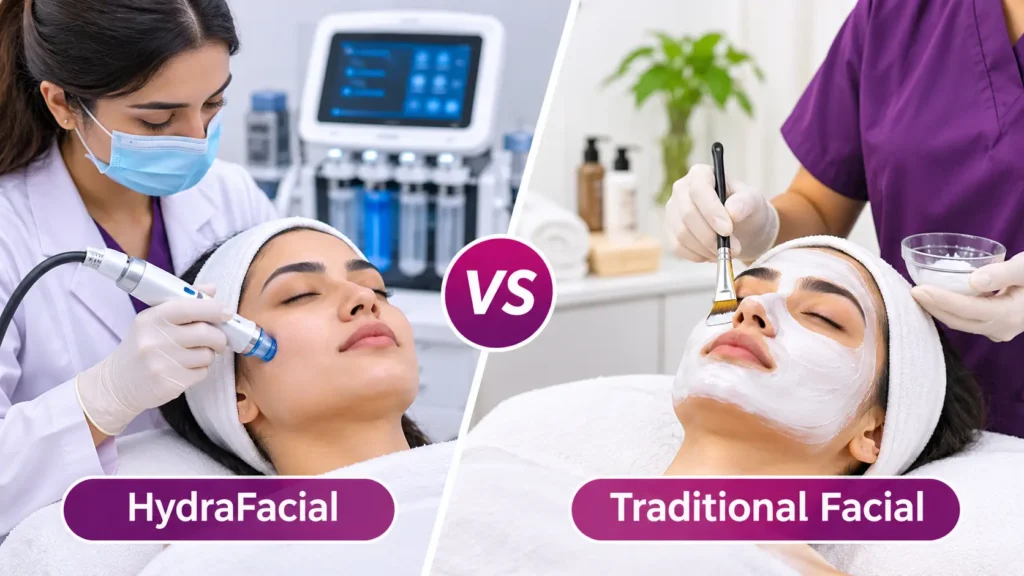
If you’re planning a facial treatment, you may be wondering whether a HydraFacial or a traditional facial is the better choice for your skin.
Both treatments involve skincare, cleansing, and techniques intended to improve the skin’s appearance. However, they differ in their methods, equipment, ingredients, and treatment experience.
A HydraFacial typically uses a specialized device to cleanse, exfoliate, extract surface debris, and deliver hydrating solutions. A traditional facial usually involves a more flexible combination of manual cleansing, exfoliation, massage, masks, and moisturizing products.
Neither treatment is automatically better for everyone. The right choice depends on your skin type, current skin condition, sensitivity, desired results, and whether either treatment is appropriate for you.
This guide explains the key differences so you can make a more informed decision.
What Is a HydraFacial?
A HydraFacial is a device-assisted facial treatment that combines several skincare steps into one procedure.
The branded HydraFacial system uses specialized technology designed to cleanse and exfoliate the skin while supporting extraction and the delivery of topical solutions.
Depending on the system and selected protocol, treatment may involve:
- Cleansing the skin
- Removing some surface dead skin cells
- Applying exfoliating solutions
- Using suction-assisted extraction
- Delivering hydrating serums
- Additional treatment steps where appropriate
The precise procedure depends on the equipment, treatment protocol, and individual skin assessment.
HydraFacial is commonly discussed for concerns involving dryness, surface congestion, and the appearance of uneven skin texture.
However, it should not be considered a cure for acne, pigmentation disorders, deep wrinkles, or permanent scarring.
Some treatments marketed as hydrofacials use different devices rather than the original branded HydraFacial system. Ask the provider which device and products are being used.
What Is a Traditional Facial?
A traditional facial is a general term for salon skincare treatments that may combine cleansing, exfoliation, massage, masks, and moisturizing.
Unlike a standardized device-assisted procedure, the exact steps can differ considerably between salons and facial packages.
A traditional facial may include:
- Skin cleansing
- Gentle exfoliation
- Steam, where appropriate
- Manual extraction, if suitable
- Facial massage
- A treatment mask
- Moisturizer and suitable finishing products
Some traditional facials focus on relaxation and hydration, while others involve more intensive cleansing or exfoliation.
Because treatments vary, the word traditional does not tell you exactly which products or procedures will be used.
A well-selected traditional facial can be appropriate for routine cosmetic skincare, depending on the individual’s skin characteristics.
HydraFacial vs. Traditional Facial: Key Differences
The main difference is how the treatments are performed.
| Feature | HydraFacial | Traditional Facial |
| Main approach | Device-assisted, multistep treatment | Usually manual and product-based |
| Cleansing | Uses specialized treatment tips and solutions | Uses cleansers and manual techniques |
| Exfoliation | Device-assisted and may involve chemical solutions | May involve scrubs, enzymes, or other exfoliants |
| Extraction | Often suction-assisted | May be manual or omitted |
| Hydration | Topical solutions delivered during treatment | Hydrating masks, serums, or moisturizers |
| Facial massage | Not necessarily a central component | Often included, depending on the package |
| Relaxation focus | Varies by treatment | Often a major part of the experience |
| Recovery | Frequently limited, but irritation can occur | Depends on products and treatment intensity |
| Cost | Often higher because of equipment and selected protocol | Varies, often with more basic options |
The outcome depends on more than the treatment name.
Product selection, practitioner technique, skin sensitivity, and appropriate treatment intensity all matter.
Which Facial Is Better for Your Skin Type?
Different skin types respond differently to exfoliation, extraction, and skincare ingredients.
1. Dry or Dehydrated Skin
Dry skin may feel tight, rough, or flaky.
Some people with dry skin may benefit from a gentle facial emphasizing hydration and careful cleansing.
A HydraFacial may be considered when the selected protocol is appropriate, but exfoliation or suction can still irritate sensitive or compromised skin.
A traditional hydrating facial may be another option when it uses mild products and avoids unnecessary exfoliation.
What matters most: Select a treatment that does not worsen dryness, irritation, or damage to the skin barrier.
2. Oily or Congested Skin
Oily skin produces more sebum and may be associated with visibly congested pores.
HydraFacial uses suction-assisted steps that may help remove some surface debris during treatment.
A traditional facial may also include suitable cleansing and extraction techniques.
However, aggressive extraction can cause irritation or skin injury.
Neither treatment permanently changes pore size or eliminates the underlying causes of excess oil production.
3. Sensitive Skin
Sensitive skin may react to fragrances, exfoliating acids, scrubs, heat, or other skincare ingredients.
Neither a HydraFacial nor a traditional facial is automatically safe for sensitive skin.
The treatment may need to be modified, postponed, or avoided.
Clients with rosacea, eczema, active irritation, or a damaged skin barrier should seek suitable professional guidance before undergoing exfoliating or suction-based procedures.
A gentler skincare approach may be more appropriate than a full facial treatment.
4. Acne-Prone Skin
Acne-prone skin can be oily, dry, sensitive, or a combination of these characteristics.
Some people with mild congestion may consider facial treatments, but active inflammatory acne, painful lesions, or significant breakouts require careful assessment.
Excessive scrubbing, suction, or manual extraction can aggravate inflammation.
A facial is not a substitute for evidence-based acne treatment.
If acne is persistent, painful, scarring, or worsening, consult a qualified healthcare professional.
5. Combination Skin
Combination skin commonly involves differences in oiliness between facial areas.
For example, the forehead and nose may be oilier than the cheeks.
Either facial approach may be considered if treatment products and techniques are adjusted appropriately.
Rather than choosing based on the name alone, explain which parts of your face feel oily, dry, irritated, or congested.
Does HydraFacial Give Better Results Than a Traditional Facial?
The answer depends on what you want to achieve.
If your main goal is a device-assisted facial involving suction-based extraction and hydration, HydraFacial may offer a treatment experience that differs from a conventional facial.
If you prefer a gentler, more relaxing salon service involving massage, masks, and basic skincare, a traditional facial may be suitable.
However, there is not enough high-quality comparative evidence to conclude that HydraFacial is universally more effective than all traditional facials.
The two categories also contain many variations, making general comparisons difficult.
Some people notice their skin feels smoother or more hydrated after a facial, but the duration and degree of improvement vary.
Neither option can guarantee permanently clearer skin, wrinkle removal, or treatment of an underlying skin disorder.
Which Facial Is Better for Glowing Skin?
The term glowing skin usually describes a cosmetic appearance rather than a medical outcome.
Cleansing, moisturizing, and removing some surface buildup can temporarily change how skin looks and feels.
Both facial types may improve the temporary appearance of the skin for some individuals.
A HydraFacial may be preferred by someone seeking a multistep, device-assisted procedure.
A traditional facial may be preferred by someone who enjoys manual skincare and hydrating masks.
Long-term skin appearance also depends on factors such as sun protection, skincare practices, underlying conditions, and individual skin characteristics.
Is HydraFacial Better for Blackheads and Clogged Pores?
HydraFacial commonly includes a suction-assisted extraction stage.
This may help remove some surface debris and material from pores during treatment.
Traditional facials may also involve extractions, but these are often performed manually.
Neither method prevents blackheads or clogged pores from returning.
People with persistent acne, inflamed lesions, or skin that becomes easily irritated should avoid aggressive extractions and seek appropriate advice.
Which Facial Is Better Before a Wedding or Special Event?
Both treatments may be considered during event preparation, but timing and skin sensitivity are important.
Trying a completely new facial immediately before an important occasion can be risky.
Some people develop temporary redness, dryness, irritation, or breakouts after cosmetic skincare procedures.
If you are preparing for bridal makeup, engagement makeup, or another special event:
- Discuss your skin sensitivity in advance.
- Avoid experimenting with unfamiliar strong treatments immediately before the event.
- Allow enough time to observe how your skin responds.
- Avoid combining several intensive skincare procedures without guidance.
- Tell your makeup artist about recent facial treatments and reactions.
A previously tolerated gentle facial may be a more predictable choice than an unfamiliar procedure shortly before a wedding.
Possible Side Effects of HydraFacial
Although HydraFacial is generally described as noninvasive, it can cause side effects.
These may include:
- Temporary redness
- Skin tightness
- Mild irritation
- Dryness or sensitivity
- Stinging from particular solutions
- Reactions to skincare ingredients
More significant irritation can occur if a treatment is unsuitable or too intensive.
Some people with active inflammatory skin conditions, infections, open lesions, or other contraindications should avoid treatment until an appropriately qualified professional confirms suitability.
The actual equipment manufacturer’s instructions and the patient’s condition must guide the procedure.
Possible Side Effects of Traditional Facials
Traditional facials also have risks.
Depending on the products and techniques used, these can include:
- Irritation from scrubs or active ingredients
- Allergic reactions to cosmetics
- Redness after massage or exfoliation
- Skin injury from aggressive extraction
- Breakouts or worsening sensitivity
- Increased pigmentation following inflammation in susceptible individuals
A facial performed manually is not automatically gentler or safer than a device-assisted treatment.
The product ingredients and technique are often more important than the treatment label.
How Much Downtime Should You Expect?
Many superficial facial treatments have little or no significant downtime for suitable clients.
However, this is not guaranteed.
Some people experience redness, dryness, sensitivity, or temporary irritation.
More intensive exfoliation, strong products, or unsuitable extraction techniques can lead to longer recovery.
People who develop worsening redness, significant pain, swelling, or an unusual reaction should seek appropriate professional advice.
Your practitioner should explain the likely aftercare requirements for the exact procedure.
What Should You Do After a Facial?
Aftercare varies by treatment type and individual skin sensitivity.
Common considerations may include:
- Use a gentle cleanser.
- Follow the recommended moisturizer routine.
- Protect your skin from excessive sun exposure.
- Avoid unnecessary rubbing or picking.
- Temporarily avoid harsh exfoliating products if advised.
- Follow specific instructions about retinoids, acids, makeup, and other skincare products.
- Seek advice if unexpected irritation develops.
A gentle, consistent skincare routine is often more useful than repeatedly applying multiple strong products.
HydraFacial vs. Traditional Facial Prices in Peshawar
Treatment cost depends on the service, equipment, products, and included steps.
At Mayo Beauty & Aesthetic in Hayatabad, Peshawar, the published HydraFacial menu includes several options.
| HydraFacial option | Published price |
| Basic HydraFacial | Rs. 3,000 |
| Deep Cleansing HydraFacial | Rs. 4,000 |
| Glow HydraFacial | Rs. 4,000 |
| Brightening HydraFacial | Rs. 4,500 |
| HydraFacial with Hyaluronic Acid | Rs. 5,000 |
| Signature HydraFacial | Rs. 7,000 |
| Deluxe HydraFacial | Rs. 8,000 |
Traditional facial costs depend on the particular package and included treatments. Contact the salon for current prices.
Before booking, confirm the equipment used, treatment steps, products, expected duration, and complete charges.
Explore HydraFacial treatments in Peshawar
How to Choose Between HydraFacial and a Traditional Facial
The right decision should begin with your skin’s current condition and your treatment goals.
Consider the following questions:
What Is Your Main Goal?
Are you seeking a relaxing salon experience, temporary hydration, gentle cleansing, or device-assisted extraction?
How Sensitive Is Your Skin?
If your skin reacts easily, tell the practitioner about previous irritation, allergies, and existing conditions.
Are You Using Active Skincare Products?
Retinoids, exfoliating acids, and certain acne products can increase skin sensitivity.
Your practitioner may recommend adjusting or postponing a procedure based on the products you use.
Do not discontinue prescription treatments without appropriate medical guidance.
Do You Have an Active Skin Condition?
Persistent acne, eczema, rosacea, infections, or unusual skin lesions may require medical assessment rather than cosmetic treatment.
What Is Your Budget?
Compare the actual treatment components and costs instead of assuming the most expensive package will produce the best results.
What Aftercare Will You Need?
Choose a treatment whose preparation and recovery requirements are compatible with your skin condition and schedule.
Choosing a Facial Treatment in Peshawar
If you are comparing facial treatments in Peshawar, look for clear explanations about what the procedure involves and which skin types or conditions may make it unsuitable.
Ask the provider about product ingredients, device type, hygiene practices, treatment limitations, and possible reactions.
Mayo Beauty & Aesthetic offers HydraFacial and traditional facial treatment options at its location in Phase 4, Hayatabad, opposite Hayatabad Medical Complex.
You can explore the individual service pages to understand the available treatments before arranging an appointment.
Frequently Asked Questions
Is HydraFacial better than a traditional facial?
Not necessarily. HydraFacial offers a device-assisted approach, while traditional facials use varying manual and product-based techniques. The better choice depends on your skin condition, goals, and suitability.
Is HydraFacial good for dry skin?
Some people with dry skin may benefit from an appropriately selected hydrating treatment. However, exfoliation, suction, and certain products can irritate sensitive or compromised skin.
Does HydraFacial remove blackheads permanently?
No. Suction-assisted extraction may remove some pore debris, but blackheads can return.
Is a traditional facial safer for sensitive skin?
Not automatically. A mild traditional facial may be suitable for some people, but fragrances, scrubs, steam, and other steps can also cause irritation.
Can HydraFacial treat acne scars?
HydraFacial is not an established treatment for removing permanent acne scars. Different scar types may require assessment for other procedures.
Which facial is better before bridal makeup?
A previously tolerated, appropriately timed treatment is generally preferable to experimenting with a new or intensive procedure immediately before an event.
Can I get a facial every month?
The suitable frequency depends on your skin, the exact treatment, and the practitioner’s recommendation. Monthly facials are not necessary for everyone.
Is HydraFacial painful?
Many people find the procedure tolerable, but suction, exfoliating solutions, or sensitive skin can cause discomfort or irritation.
Can I wear makeup after a facial?
It depends on the treatment and how your skin responds. Follow your practitioner’s product-specific and procedure-specific advice.
How much does HydraFacial cost in Peshawar?
Mayo Beauty & Aesthetic lists HydraFacial options from Rs. 3,000 to Rs. 8,000, depending on the selected package.
Final Verdict: HydraFacial or Traditional Facial?
HydraFacial and traditional facials can both have a place in cosmetic skincare.
HydraFacial uses a specialized, device-assisted process involving cleansing, exfoliation, extraction, and hydration. A traditional facial generally offers a more flexible combination of manual skincare techniques, masks, and moisturizing.
The choice should be based on your skin condition, preferences, budget, and the actual procedure being offered.
Neither treatment guarantees flawless skin or replaces medical care for persistent skin problems.
If you are uncertain, discussing your concerns with a qualified skincare professional can help you avoid treatments that may be unsuitable.
Explore Facial Treatments at Mayo Beauty & Aesthetic
Mayo Beauty & Aesthetic offers facial treatment options for clients in Hayatabad and other areas of Peshawar.
Review our HydraFacial and Traditional Facial service pages, or contact our team to discuss current treatment options and appointment availability.
if you are looking for beauty salon and Aesthetic Clinic Services around Peshawar
Location: Office 209, 2nd Floor, Dean’s Medicine Center, opposite Hayatabad Medical Complex, Phase 4, Hayatabad, Peshawar, Pakistan
Phone / WhatsApp: 0300-6199777
Email: info@mayobeauty.pk