Acne scars can remain long after active breakouts have cleared. Some appear as shallow depressions, while others form deeper marks, uneven texture, or raised areas.
Two commonly discussed treatment options are microneedling and chemical peels. Both are used in aesthetic and dermatological care, but they work differently and are not equally suitable for every scar type.
So, is microneedling or a chemical peel better for acne scars?
The answer depends on the type and depth of scarring, skin characteristics, medical history, and the procedure being considered.
Microneedling may help reduce the appearance of certain depressed acne scars by stimulating collagen remodeling. Chemical peels use controlled chemical exfoliation and, depending on the type and depth, may improve selected surface changes and some acne scars.
Research suggests that both approaches can benefit certain patients, but neither is universally superior.
This guide explains the differences, what current research shows, and the important factors to consider before choosing a procedure.
What Are Acne Scars?
Acne scars develop when inflammation and the skin’s healing response alter the normal structure of the skin.
Some scars form when the skin loses supporting tissue during healing. Others develop when excessive tissue is produced.
Acne scars can differ in depth, texture, color, and appearance.
They should also be distinguished from post-acne marks.
A flat brown or red mark that remains after a pimple is not necessarily a permanent structural scar. These marks may be associated with post-inflammatory pigmentation or redness.
Choosing the correct treatment begins with identifying what is actually present.
Understanding Different Types of Acne Scars
Ice Pick Scars
Ice pick scars are narrow, relatively deep depressions that extend into the skin.
Because of their shape and depth, superficial procedures may provide limited improvement.
Certain targeted techniques or surgical approaches may be more appropriate after specialist assessment.
Boxcar Scars
Boxcar scars are depressed scars with relatively defined edges.
They may be shallow or deep.
Treatment selection depends on their depth, width, and individual characteristics.
Some shallow boxcar scars may respond to collagen-remodeling or resurfacing procedures, while deeper scars may require other techniques.
Rolling Scars
Rolling scars produce a wave-like or uneven appearance.
They can result from fibrous bands that pull the skin downward.
Procedures such as subcision may be considered when the scar is tethered beneath the surface.
Microneedling or resurfacing alone may not adequately address every tethered scar.
Raised Acne Scars
Hypertrophic and keloid scars develop when excess scar tissue forms.
They require a different treatment approach from depressed scars.
Microneedling or a routine cosmetic chemical peel may be unsuitable and could potentially worsen certain raised scars.
A qualified dermatologist should assess these concerns before treatment.
What Is Microneedling?
Microneedling is a minimally invasive medical aesthetic procedure that uses fine needles to create controlled microscopic punctures in the skin.
These punctures initiate a wound-healing response.
As the skin heals, collagen remodeling may help reduce the appearance of certain depressed acne scars.
Microneedling is sometimes called collagen induction therapy.
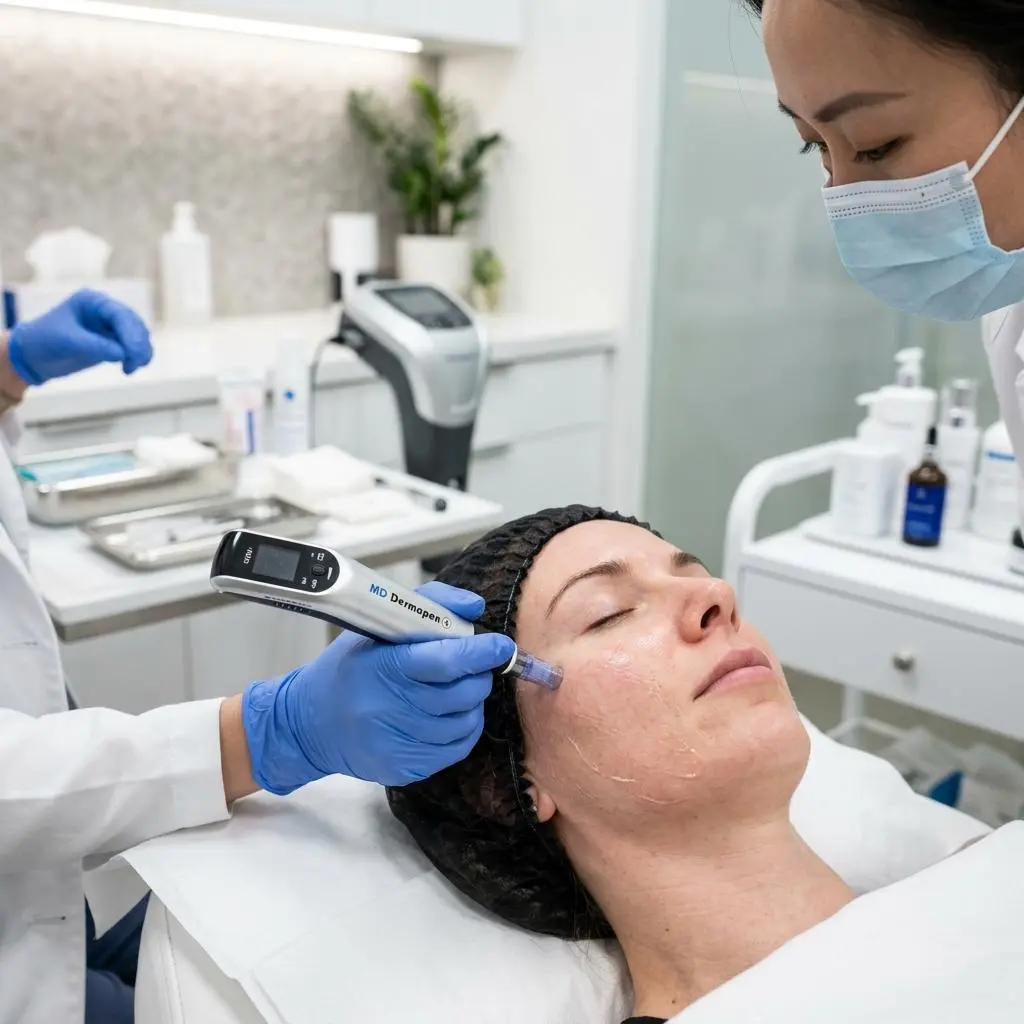
The treatment is performed using a suitable device, such as a medical microneedling pen.
Treatment depth and technique depend on the skin concern, treatment area, individual characteristics, and the practitioner’s assessment.
Microneedling does not physically erase scars.
Instead, the goal is to achieve gradual improvement in selected areas through the skin’s healing response.
How Does Microneedling Help Acne Scars?
Atrophic acne scars involve a loss or alteration of supporting skin tissue.
Microneedling creates controlled skin injuries that can stimulate remodeling during healing.
Over time, this may make some depressed scars less noticeable.
The response depends on several factors:
- Scar type and depth
- Skin characteristics
- Needle depth and procedure technique
- Healing response
- Treatment schedule
- Individual medical factors
- Other procedures used when appropriate
Microneedling may be considered for selected rolling scars and shallow boxcar scars.
However, deep ice pick scars and strongly tethered scars may require other treatments.
A clinical assessment is necessary before determining the likely benefit.
What Are Chemical Peels?
Chemical peels are procedures in which specific chemical agents are applied to the skin to produce controlled exfoliation or skin resurfacing.
Different chemical peels vary in strength and depth.
A superficial peel acts mainly on the outer layers of the skin, while deeper peels affect additional layers and carry greater risks.
Chemical peels may be used for selected cosmetic concerns involving texture, uneven pigmentation, and some acne-related skin changes.
For acne scarring, results depend on the peel type, concentration, application technique, scar characteristics, and treatment depth.
Not every chemical peel is designed to treat structural acne scars.
A basic salon peel should not be assumed equivalent to a medical procedure used for scar treatment.
How Do Chemical Peels Help Acne Scars?
Some chemical peels can improve selected surface irregularities through controlled exfoliation and subsequent skin renewal.
Certain medical peeling techniques may also stimulate remodeling that reduces the appearance of some depressed scars.
The potential effect varies substantially.
Superficial peels may be more useful for selected surface texture or pigmentation concerns than for deep structural scarring.
More intensive procedures require careful patient selection and professional expertise.
Chemical peels cannot guarantee complete acne scar removal.
Microneedling vs. Chemical Peels: Key Differences
Both procedures may be used for selected acne scar concerns, but they operate through different mechanisms.
| Feature | Microneedling | Chemical Peels |
| Main method | Controlled skin punctures | Controlled chemical exfoliation or resurfacing |
| Primary mechanism | Wound healing and collagen remodeling | Exfoliation and variable-depth skin remodeling |
| Potential use | Selected depressed scars and uneven texture | Selected surface changes and certain acne scars |
| Treatment intensity | Depends on needle depth and technique | Depends on peeling agent, concentration, and depth |
| Discomfort | Needling-related discomfort or tenderness | Stinging, burning, or irritation |
| Recovery | Redness and sensitivity commonly occur | Peeling, redness, and sensitivity vary by peel depth |
| Pigmentation risk | Possible, especially after inflammation | Possible, particularly with unsuitable or intensive peels |
| Sessions | Often requires a series | Depends on peel type and clinical indication |
Neither procedure is automatically the best choice.
A treatment that is suitable for a shallow scar may not be appropriate for a deep or raised scar.
Which Treatment Works Better for Atrophic Acne Scars?
Atrophic scars are depressed scars caused by a loss of supporting tissue.
Both microneedling and selected chemical peels have been studied for these scars.
A 2026 systematic review and meta-analysis examined 11 studies involving 713 participants.
The researchers found no statistically significant difference between the two approaches in the likelihood of achieving substantial acne scar improvement.
However, microneedling was associated with a greater likelihood of achieving at least some improvement in the studies assessing that outcome.
The evidence varied in quality, and different studies used different treatment protocols and measurements.
The practical conclusion is that neither procedure can be considered universally superior for atrophic acne scars.
The appropriate choice depends on the scar pattern, skin characteristics, procedure intensity, and individual risks.
Which Treatment Is Better for Deep Acne Scars?
Deep scars can be more difficult to improve than superficial irregularities.
Ice pick scars, deep boxcar scars, and tethered rolling scars may need techniques that directly address their structure.
A superficial chemical peel is unlikely to adequately correct deep scars.
Microneedling alone may also provide limited improvement for certain deep or tethered scars.
A dermatologist may consider other procedures, including targeted scar treatments, subcision, laser resurfacing, or selected surgical techniques.
Treatment planning should focus on the scar’s actual structure rather than relying on a single popular procedure.
Which Treatment Is Better for Acne Marks and Pigmentation?
Post-acne pigmentation and acne scars are not the same condition.
Dark marks remaining after acne may represent post-inflammatory hyperpigmentation rather than depressed scars.
Some properly selected chemical peels can be considered for pigmentary concerns.
Microneedling may also be considered for certain skin conditions, but it is not automatically the first choice for pigmentation.
Inappropriate treatment can worsen discoloration.
This is particularly important for people prone to post-inflammatory hyperpigmentation.
A qualified practitioner should identify whether the concern is pigmentation, structural scarring, or a combination of both.
Are Microneedling and Chemical Peels Safe for Darker Skin Tones?
Both procedures can be performed on selected patients with darker skin tones, but appropriate technique and patient assessment are essential.
Darker skin may be more susceptible to post-inflammatory pigmentation changes following certain types of skin injury.
Microneedling is often considered an option across a wide range of skin tones when performed correctly.
Chemical peel risks depend heavily on the peeling agent, concentration, treatment depth, and preparation.
Possible complications include prolonged discoloration, irritation, and scarring.
A practitioner should assess previous pigmentation problems, skin sensitivity, treatment history, and other relevant risk factors.
Neither treatment should be described as completely risk-free for any skin tone.
Is Microneedling More Painful Than Chemical Peels?
The experience differs between treatments.
Microneedling may cause temporary puncture-related discomfort, tenderness, and sensitivity.
Topical anesthetic may be used where clinically appropriate.
Chemical peels may produce stinging, warmth, or a burning sensation depending on the formulation and treatment intensity.
A more intensive peel can involve greater discomfort and longer healing.
Individual pain tolerance varies.
The expected sensation and available pain-management options should be discussed before treatment.
Recovery and Downtime: What Should You Expect?
Recovery is one of the important differences when comparing procedures.
Microneedling Recovery
After microneedling, the skin may feel sensitive, warm, or mildly swollen.
Redness or a darker inflamed appearance can occur depending on skin tone.
Some patients return to ordinary activities relatively quickly, but visible reactions may last several days or longer.
The recovery period depends on needle depth, treatment intensity, and individual healing.
Chemical Peel Recovery
Recovery after chemical peeling varies considerably.
A superficial peel may cause temporary redness, dryness, or mild flaking.
Medium-depth and deeper peels may involve more substantial peeling, irritation, and longer recovery.
Some chemical peels require additional preparation and follow-up.
A deeper peel should not be treated as a routine salon facial.
The responsible practitioner should explain the expected downtime for the exact procedure being considered.
Possible Side Effects and Risks
Both treatments involve controlled skin injury and therefore carry potential complications.
Microneedling Risks
Possible effects include:
- Redness
- Swelling
- Tenderness
- Temporary skin sensitivity
- Pinpoint bleeding
- Infection
- Post-inflammatory pigmentation changes
- Scarring
Chemical Peel Risks
Possible effects include:
- Burning or irritation
- Redness
- Dryness and peeling
- Allergic or irritant reactions
- Pigmentation changes
- Infection
- Scarring
- Prolonged recovery after more intensive peels
The likelihood and severity of complications depend on the procedure and individual factors.
Patients should receive clear information about the risks before providing informed consent.
Who Should Avoid or Postpone These Treatments?
Not everyone is an appropriate candidate.
A practitioner may recommend postponing or avoiding a procedure when there is:
- Active skin infection
- Severe inflammatory acne in the proposed treatment area
- Significant sunburn or recent tanning
- Poor wound healing
- A history of abnormal scarring
- Certain medical conditions affecting healing
- Relevant medication use
- Other procedure-specific contraindications
Treatment decisions may also be affected by pregnancy or breastfeeding.
The suitability of microneedling and chemical peels must be assessed separately because their contraindications are not identical.
Do not stop prescribed medication or use strong skin-preparation products without suitable professional guidance.
How Many Sessions Are Usually Required?
Some people need multiple treatment sessions for meaningful improvement.
The number of microneedling sessions depends on scar type, depth, individual healing, and the treatment protocol.
Chemical peel schedules vary even more because peeling agents range from superficial to deeper procedures.
A dermatologist may recommend a series of mild or medium peels, while some intensive procedures require a different approach.
There is no universally appropriate session count for every acne scar.
The practitioner should explain how progress will be assessed and why repeated treatment may be recommended.
How Long Does It Take to See Results?
Acne scar improvement is generally gradual.
With microneedling, changes associated with collagen remodeling may develop over weeks or months.
Chemical peeling results depend on treatment depth and the skin’s healing process.
Superficial changes may become noticeable sooner, while structural scar improvement can require more time.
Initial redness, swelling, or peeling can temporarily affect how the skin looks.
Results vary, and complete scar removal should not be expected.
Can Microneedling and Chemical Peels Be Combined?
Certain clinical treatment plans may combine microneedling and chemical peeling.
Research has investigated combination approaches for atrophic acne scars.
A systematic review involving 566 participants reported more favorable outcomes for selected combined protocols than for either procedure alone.
However, these results do not mean every combination is safe or appropriate.
Combining procedures can increase the complexity of treatment and requires suitable expertise, timing, and aftercare.
Patients should not combine professional microneedling with strong home chemical peels.
A qualified medical practitioner should determine whether combination treatment is appropriate.
Are PRP or Laser Treatments Better for Some Acne Scars?
In some cases, microneedling or chemical peeling alone may not address the underlying scar structure adequately.
Depending on the scar type, other options may include:
- PRP-assisted treatment
- Laser resurfacing
- Subcision
- Targeted scar procedures
- Other medically appropriate approaches
Some patients may benefit from more than one type of treatment.
However, combining procedures is not always necessary, and no combination guarantees complete scar removal.
The best approach depends on professional scar assessment.
How to Choose Between Microneedling and Chemical Peels
Before deciding, consider several important questions.
What Type of Acne Scars Do You Have?
Depressed, raised, deep, and superficial scars require different treatment approaches.
Do You Still Have Active Acne?
Active inflammatory acne may need appropriate treatment before certain scar procedures can be performed.
Is Your Main Concern Scarring or Pigmentation?
Structural scars and post-acne marks are different problems.
Their treatment options may also differ.
What Is Your Skin Type and Pigmentation History?
Previous discoloration, irritation, or abnormal scarring can influence the safety of a proposed procedure.
How Much Downtime Can You Manage?
Some treatments require more recovery time than others.
Choose a procedure only after understanding its likely healing requirements.
What Results Are Realistic?
Ask whether the procedure is expected to provide mild, moderate, or more substantial improvement and how uncertain the outcome may be.
Who Will Perform the Treatment?
Microneedling for acne scars and medical-depth chemical peels require appropriate training, clinical knowledge, and infection-control precautions.
The qualifications and experience of the treating professional matter.
Acne Scar Treatment in Peshawar: What Should You Consider?
If you’re researching acne scar treatments in Peshawar, begin by understanding the type of scarring you have.
Mayo Beauty & Aesthetic offers aesthetic treatment options including microneedling, chemical peels, and selected acne scar procedures at its clinic in Hayatabad.
A suitable consultation should consider your skin condition, treatment goals, medical history, and individual risk factors.
The choice of procedure should not depend solely on price or a treatment’s popularity.
Before booking, confirm the procedure, practitioner qualifications, expected recovery, possible complications, and complete treatment cost.
For more detailed service information, explore the Mayo Beauty & Aesthetic Microneedling, Chemical Peels, and Acne Scar Treatment pages.
Frequently Asked Questions
Is microneedling better than chemical peels for acne scars?
Not always. Research suggests both can help selected atrophic acne scars, with no clear overall superiority for substantial improvement. Suitability depends on the scar type and patient characteristics.
Can chemical peels remove deep acne scars?
Superficial chemical peels are generally unlikely to correct deep structural scars. Some scars require targeted treatments or combination procedures.
Does microneedling permanently remove acne scars?
No. Microneedling may reduce the appearance of selected scars, but complete or permanent scar removal cannot be guaranteed.
Which treatment is better for ice pick scars?
Deep ice pick scars may require targeted procedures. Neither routine microneedling nor a superficial chemical peel is automatically the most appropriate choice.
Can chemical peels help with post-acne dark spots?
Certain chemical peels may be considered for selected pigmentation concerns, but inappropriate treatment can worsen discoloration.
Is microneedling safe for darker skin?
Microneedling can be suitable for a range of skin tones when performed appropriately. However, pigmentation changes, infection, and scarring remain possible.
Which procedure has less downtime?
Recovery varies with treatment intensity. Superficial peels and some microneedling protocols may have relatively limited downtime, while deeper peels require longer healing.
How many sessions will I need?
There is no universal number. Treatment schedules depend on scar severity, procedure type, individual response, and clinical assessment.
Can microneedling and chemical peels be combined?
Some medically supervised protocols combine them. However, a qualified practitioner must assess suitability, timing, and additional risks.
Can I treat acne scars at home with a dermaroller?
At-home devices that puncture the skin carry risks of infection, injury, and scarring. Professional assessment and appropriate treatment are preferable for structural acne scars.
Which treatment should I choose for acne scars in Peshawar?
The appropriate option depends on scar type, skin characteristics, medical history, and expected benefits and risks. Consult a suitably qualified practitioner before proceeding.
Final Verdict: Microneedling or Chemical Peels?
Microneedling and chemical peels may both help certain acne scar concerns, but they work through different mechanisms.
Microneedling focuses on controlled skin punctures and collagen remodeling. Chemical peels use chemical exfoliation or resurfacing, with effects depending on the treatment depth.
Clinical evidence does not establish one universally superior option for atrophic acne scars.
Deep, raised, or tethered scars may need other procedures, and some patients require more than one treatment approach.
The most important first step is an accurate assessment of the scars rather than choosing a procedure based on popularity alone.
Explore Acne Scar Treatments at Mayo Beauty & Aesthetic
If you are considering acne scar treatment in Peshawar, Mayo Beauty & Aesthetic offers consultations for selected skin concerns and aesthetic treatment options.
Our clinic provides information about microneedling, chemical peels, laser procedures, and related treatments.
Contact our team to discuss consultation availability and the next steps for understanding your treatment options.
Mayo Beauty & Aesthetic
Location: Hayatabad Phase 4, opposite Hayatabad Medical Complex, Peshawar, Pakistan
Phone / WhatsApp: 0300-6199777
Email: info@mayobeauty.pk